Your Toxic Habits Aren't the Problem, this Is.
Your Toxic Habits Aren't the Problem, this Is.
No headings found on page
The real reason you keep going back to numbing habits has nothing to do with willpower.
Why You Keep Going Back to Bad Habits
This morning I woke up and spent the first hour scrolling on my phone. Cat videos. Pointless stuff. And I knew it wasn't helping me — but I did it anyway.
Here's what most people do when they catch themselves in a bad habit: they go straight to blame. "I'm lazy." "I have no willpower." "Something is wrong with me."
That framing is wrong. And it's keeping you stuck.
When something negative happens in your life — your boss criticizes you, a relationship falls apart, you feel lost about the future — your brain doesn't pause to process it. It immediately looks for a way out. A strategy to get rid of the bad feeling as fast as possible.
For me, when I broke up with my ex, I didn't let myself feel the pain. I started drinking again. I watched Netflix every night. My whole week became a series of strategies to avoid that one uncomfortable feeling. And it worked — for about five minutes. Then I was back in the same loop.
That's the trap. The habit gives you temporary relief, so your brain logs it as a successful coping strategy. Next time you feel bad, it goes back to that same playbook. Over and over.
The real question isn't "why do I have these habits?"
The real question is: what are you avoiding?
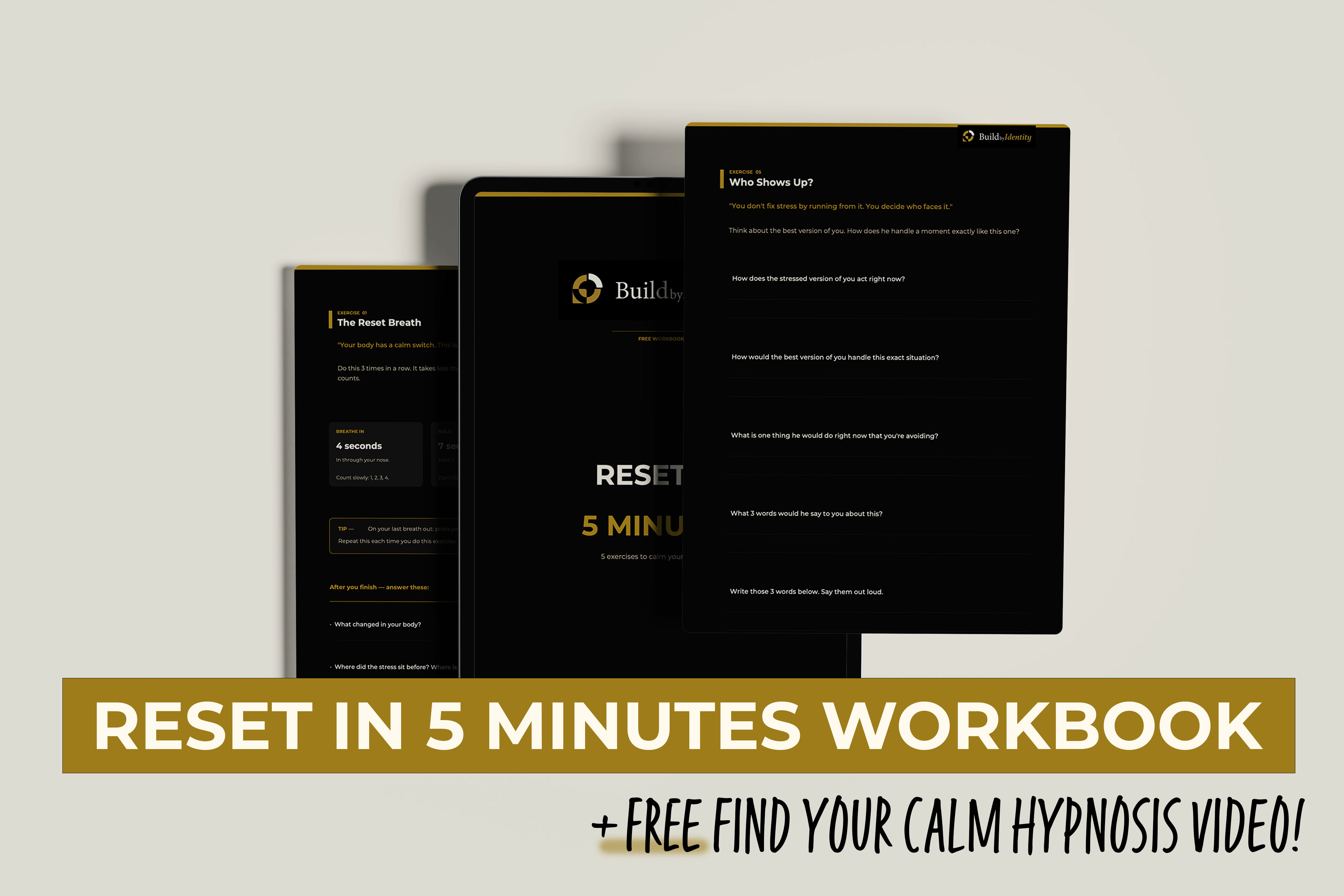
If you're feeling overwhelmed right now, I created a free workbook that helps you clear stress in under five minutes, with a guided meditation included.
The Three Unmet Needs Behind Every Numbing Habit
Numbing doesn't happen randomly. It's always pointing at something. In almost every case, it comes back to one of three unmet needs:
Connection
You feel isolated. You don't have people around you who actually get what you're going through. The numbing fills the silence.Control
Something in your life feels unstable or unpredictable. Maybe you left a steady job to start a business and for five months you're not earning anything. Every time the thought "I'm going to lose everything" shows up, your brain triggers the escape hatch.Meaning
You're going through the motions but nothing feels worth it. There's no direction. You're doing things but they don't add up to anything you actually care about.
When these needs are being met, you feel whole. When one of them is missing, you feel incomplete — restless, uncertain, like something is off even when you can't explain it.Exercise: Think about the last time you caught yourself numbing. What was happening right before? Now ask yourself — which of these three was missing in that moment? Connection, control, or meaning? Be honest. Write it down.
Coaching with me is built around finding these exact patterns and breaking them. If you want to do that work directly, [book a session here.]
The ABC Method: How to Find the Real Trigger
This is a tool from CBT (Cognitive Behavioral Therapy_ — called the ABC Method. It helps you go from "I keep doing this habit" to actually understanding why.
Most people try to change C — the consequence, the behavior, the habit itself. That's why it doesn't last. The real leverage is at B: the belief underneath.
Here's how it works:
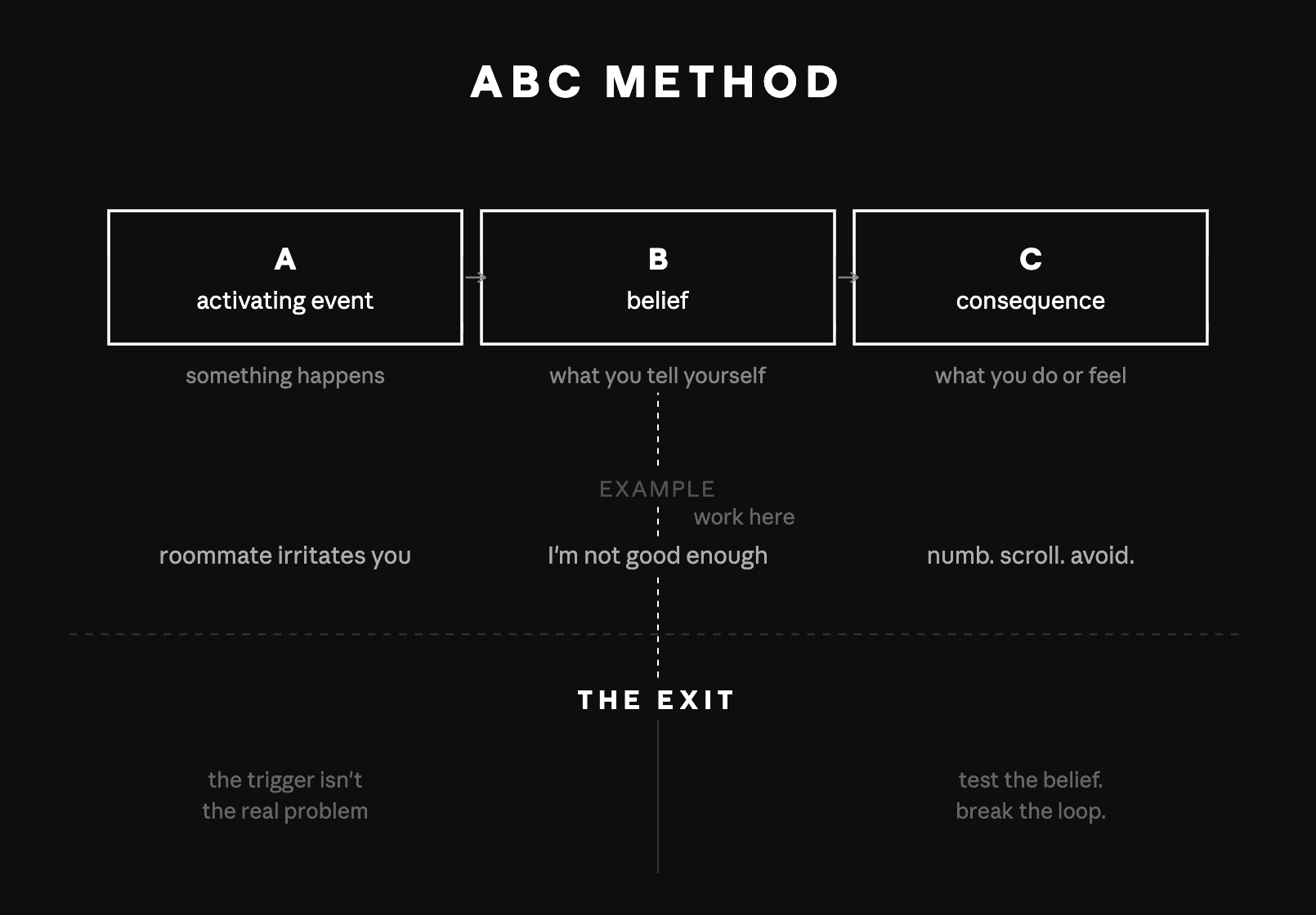
A — Trigger or Activating event: What happened? What was the situation?
B — Belief: What did you tell yourself about it?
C — Consequence: What did you do as a result?
A real example from my own life:
This morning, I felt overstimulated. My roommates said something that irritated me and I felt angry. So my consequence was victim mentality — feeling like everything was going wrong and I needed to escape.
But when I actually sat with it, I realized my roommates weren't the trigger. I had woken up that morning and spent hours on my phone. I had a video to film and I kept avoiding it. By the afternoon, the frustration wasn't with them — it was with myself.
When I dug into the belief behind it, I found it: not feeling good enough.
That belief had been there long before this morning. Growing up in foster care, switching families, constantly losing friendships — that experience left behind a feeling that I wasn't enough. It had been following me around my whole life, and it showed up again today disguised as irritation with my roommates.
How to do this yourself:
Grab a notebook. Write down A, B, and C with some space between each.
Start with a situation where you recently numbed — what happened? (A)
What was the consequence — what did you actually do? (C)Now look at the gap between A and C. What belief would have to be true for that behavior to make sense? (B) That belief at B is what you're actually dealing with.
Want help working through your own ABC? That's exactly what 1:1 coaching is for — in person in Barcelona or online.
How to Challenge the Belief That's Keeping You Stuck
Finding the belief is step one. But beliefs feel true — especially the ones that have been with you since childhood. So you have to test them.
Two questions to work with:
What evidence do I have that this belief is true?
Be honest. For me and "not feeling good enough" — my past gave me a lot of material. Foster care. Constant disruption. Not feeling stable or wanted. That experience genuinely confirmed the belief for years.What evidence do I have that this belief is NOT true?
This is where it shifts. I've done public speaking. I moved to Barcelona on my own. I've built real friendships. I've made money. I've published over 70 YouTube videos. I've gone from a difficult past to a life I actually chose.
When you look at the full picture — not just the moments that confirm your fear — the belief starts to lose its grip.
The belief isn't a fact. It's a story your brain developed to make sense of old pain. And you can update the story when you have new evidence.
The habit isn't the enemy. The untested belief underneath it is.
When you keep skipping this part and just trying to change the habit, the belief stays intact. Every new trigger pulls you right back to the same consequence. But when you address the belief directly, the whole loop starts to break down.
The Bottom Line
Numbing habits aren't a character flaw. They're your brain doing what it was built to do — protect you from pain as fast as possible. The real work is figuring out which unmet need (connection, control, or meaning) is driving the behavior. Use the ABC method to trace the habit back to the belief underneath it. Then test that belief against real evidence from your life — not just the moments that confirm your worst fears about yourself. That's how the loop breaks.
FAQ
What causes numbing habits in the first place?
Numbing habits develop as a coping response to emotional discomfort. When something painful happens and you don't have a way to process it, your brain finds the fastest route to relief — scrolling, drinking, binge-watching, gaming. Over time that route becomes automatic. The habit isn't the cause of the problem; it's a symptom of an unmet need underneath it.How do I know if I'm numbing or just relaxing?
The difference is awareness and intention. Relaxing is a conscious choice you make when you've done what you needed to do. Numbing is what happens when you're trying to avoid a feeling. If you feel worse after doing it, or you didn't really choose it so much as fall into it — it's numbing.What are the three unmet needs behind most numbing habits?
Connection, control, and meaning. When one of these is missing, you feel incomplete and restless — and that discomfort drives the habit. Identifying which one is missing in your specific situation is the starting point for actually solving it.What is the ABC method and how does it help?
The ABC method comes from Cognitive Behavioral Therapy. A is the trigger (the situation), B is the belief (what you told yourself about it), and C is the consequence (what you did). Most people try to change C directly and wonder why nothing sticks. The real work happens at B — identifying and challenging the belief that drives the behavior.What if I've tried to stop numbing habits before and it didn't work?
Then you were working on the wrong level. Willpower-based approaches target the habit itself without addressing what's underneath it. If you want real change, you need to identify the belief that's running the pattern. That's deeper work — and it's the kind of work we do in 1:1 coaching. Book a session here.
About the Author
Ronald Foks is the founder of BuildByIdentity — a coaching brand for young men focused on identity, mental strength, and becoming who you actually want to be. He grew up in foster care, dealt with an alcoholic father, and turned those experiences into a real coaching methodology grounded in CBT, NLP, and Logotherapy. He works with men 1:1 in Barcelona and online.
Follow his YouTube channel at youtube.com/@RonaldFoks.
Watch the video version here
The real reason you keep going back to numbing habits has nothing to do with willpower.
Why You Keep Going Back to Bad Habits
This morning I woke up and spent the first hour scrolling on my phone. Cat videos. Pointless stuff. And I knew it wasn't helping me — but I did it anyway.
Here's what most people do when they catch themselves in a bad habit: they go straight to blame. "I'm lazy." "I have no willpower." "Something is wrong with me."
That framing is wrong. And it's keeping you stuck.
When something negative happens in your life — your boss criticizes you, a relationship falls apart, you feel lost about the future — your brain doesn't pause to process it. It immediately looks for a way out. A strategy to get rid of the bad feeling as fast as possible.
For me, when I broke up with my ex, I didn't let myself feel the pain. I started drinking again. I watched Netflix every night. My whole week became a series of strategies to avoid that one uncomfortable feeling. And it worked — for about five minutes. Then I was back in the same loop.
That's the trap. The habit gives you temporary relief, so your brain logs it as a successful coping strategy. Next time you feel bad, it goes back to that same playbook. Over and over.
The real question isn't "why do I have these habits?"
The real question is: what are you avoiding?
If you're feeling overwhelmed right now, I created a free workbook that helps you clear stress in under five minutes, with a guided meditation included.
The Three Unmet Needs Behind Every Numbing Habit
Numbing doesn't happen randomly. It's always pointing at something. In almost every case, it comes back to one of three unmet needs:
Connection
You feel isolated. You don't have people around you who actually get what you're going through. The numbing fills the silence.Control
Something in your life feels unstable or unpredictable. Maybe you left a steady job to start a business and for five months you're not earning anything. Every time the thought "I'm going to lose everything" shows up, your brain triggers the escape hatch.Meaning
You're going through the motions but nothing feels worth it. There's no direction. You're doing things but they don't add up to anything you actually care about.
When these needs are being met, you feel whole. When one of them is missing, you feel incomplete — restless, uncertain, like something is off even when you can't explain it.Exercise: Think about the last time you caught yourself numbing. What was happening right before? Now ask yourself — which of these three was missing in that moment? Connection, control, or meaning? Be honest. Write it down.
Coaching with me is built around finding these exact patterns and breaking them. If you want to do that work directly, [book a session here.]
The ABC Method: How to Find the Real Trigger
This is a tool from CBT (Cognitive Behavioral Therapy_ — called the ABC Method. It helps you go from "I keep doing this habit" to actually understanding why.
Most people try to change C — the consequence, the behavior, the habit itself. That's why it doesn't last. The real leverage is at B: the belief underneath.
Here's how it works:
A — Trigger or Activating event: What happened? What was the situation?
B — Belief: What did you tell yourself about it?
C — Consequence: What did you do as a result?
A real example from my own life:
This morning, I felt overstimulated. My roommates said something that irritated me and I felt angry. So my consequence was victim mentality — feeling like everything was going wrong and I needed to escape.
But when I actually sat with it, I realized my roommates weren't the trigger. I had woken up that morning and spent hours on my phone. I had a video to film and I kept avoiding it. By the afternoon, the frustration wasn't with them — it was with myself.
When I dug into the belief behind it, I found it: not feeling good enough.
That belief had been there long before this morning. Growing up in foster care, switching families, constantly losing friendships — that experience left behind a feeling that I wasn't enough. It had been following me around my whole life, and it showed up again today disguised as irritation with my roommates.
How to do this yourself:
Grab a notebook. Write down A, B, and C with some space between each.
Start with a situation where you recently numbed — what happened? (A)
What was the consequence — what did you actually do? (C)Now look at the gap between A and C. What belief would have to be true for that behavior to make sense? (B) That belief at B is what you're actually dealing with.
Want help working through your own ABC? That's exactly what 1:1 coaching is for — in person in Barcelona or online.
How to Challenge the Belief That's Keeping You Stuck
Finding the belief is step one. But beliefs feel true — especially the ones that have been with you since childhood. So you have to test them.
Two questions to work with:
What evidence do I have that this belief is true?
Be honest. For me and "not feeling good enough" — my past gave me a lot of material. Foster care. Constant disruption. Not feeling stable or wanted. That experience genuinely confirmed the belief for years.What evidence do I have that this belief is NOT true?
This is where it shifts. I've done public speaking. I moved to Barcelona on my own. I've built real friendships. I've made money. I've published over 70 YouTube videos. I've gone from a difficult past to a life I actually chose.
When you look at the full picture — not just the moments that confirm your fear — the belief starts to lose its grip.
The belief isn't a fact. It's a story your brain developed to make sense of old pain. And you can update the story when you have new evidence.
The habit isn't the enemy. The untested belief underneath it is.
When you keep skipping this part and just trying to change the habit, the belief stays intact. Every new trigger pulls you right back to the same consequence. But when you address the belief directly, the whole loop starts to break down.
The Bottom Line
Numbing habits aren't a character flaw. They're your brain doing what it was built to do — protect you from pain as fast as possible. The real work is figuring out which unmet need (connection, control, or meaning) is driving the behavior. Use the ABC method to trace the habit back to the belief underneath it. Then test that belief against real evidence from your life — not just the moments that confirm your worst fears about yourself. That's how the loop breaks.
FAQ
What causes numbing habits in the first place?
Numbing habits develop as a coping response to emotional discomfort. When something painful happens and you don't have a way to process it, your brain finds the fastest route to relief — scrolling, drinking, binge-watching, gaming. Over time that route becomes automatic. The habit isn't the cause of the problem; it's a symptom of an unmet need underneath it.How do I know if I'm numbing or just relaxing?
The difference is awareness and intention. Relaxing is a conscious choice you make when you've done what you needed to do. Numbing is what happens when you're trying to avoid a feeling. If you feel worse after doing it, or you didn't really choose it so much as fall into it — it's numbing.What are the three unmet needs behind most numbing habits?
Connection, control, and meaning. When one of these is missing, you feel incomplete and restless — and that discomfort drives the habit. Identifying which one is missing in your specific situation is the starting point for actually solving it.What is the ABC method and how does it help?
The ABC method comes from Cognitive Behavioral Therapy. A is the trigger (the situation), B is the belief (what you told yourself about it), and C is the consequence (what you did). Most people try to change C directly and wonder why nothing sticks. The real work happens at B — identifying and challenging the belief that drives the behavior.What if I've tried to stop numbing habits before and it didn't work?
Then you were working on the wrong level. Willpower-based approaches target the habit itself without addressing what's underneath it. If you want real change, you need to identify the belief that's running the pattern. That's deeper work — and it's the kind of work we do in 1:1 coaching. Book a session here.
About the Author
Ronald Foks is the founder of BuildByIdentity — a coaching brand for young men focused on identity, mental strength, and becoming who you actually want to be. He grew up in foster care, dealt with an alcoholic father, and turned those experiences into a real coaching methodology grounded in CBT, NLP, and Logotherapy. He works with men 1:1 in Barcelona and online.
Follow his YouTube channel at youtube.com/@RonaldFoks.
Watch the video version here
Post Navigation
Back to Blog
About
Coaching
Social
Contact