Feeling Lost in Life With No Direction? Read This First.
Feeling Lost in Life With No Direction? Read This First.
No headings found on page
You wake up. You scroll. You see another guy your age launching a business, building his body, traveling the world — and you're still here, stuck in the same spot, wondering what the hell is wrong with you.
You have this feeling that you have no direction. That everyone around you has it figured out except you. That you should be further along by now.
I know that feeling. Most of my teenage years I felt exactly that way.
But here's what I also figured out: there's a way out. And it probably starts with something you're not expecting — you might just be doing too much, and for all the wrong reasons.
In this article, I'll break down why you feel lost, what's actually keeping you stuck, and the one shift that changed everything for me.
→ Scroll down to watch the YouTube video of this article.
Why You Feel Lost in Life
First, let's be honest about what's actually going on.
Feeling lost isn't just about not knowing what career to pick or what goal to chase. It's deeper than that. It's this low-grade weight of emptiness — the feeling that you don't belong anywhere, that you're falling behind, that something is fundamentally wrong with you.
Most guys who feel this way share the same pattern: they're overwhelmed by everything they think they should be doing, and underwhelmed by everything they're actually doing.
You tell yourself you need to hit the gym every day, read five pages every morning, build your business, improve your social skills, quit bad habits — all at the same time. And when you don't? You feel like a failure. Not just someone who missed a workout. A failure as a person.
That weight is exhausting. And it's not driving you forward — it's keeping you stuck.
The Problem With Performance Culture
Here's something nobody talks about enough, especially in Western Europe where I'm from.
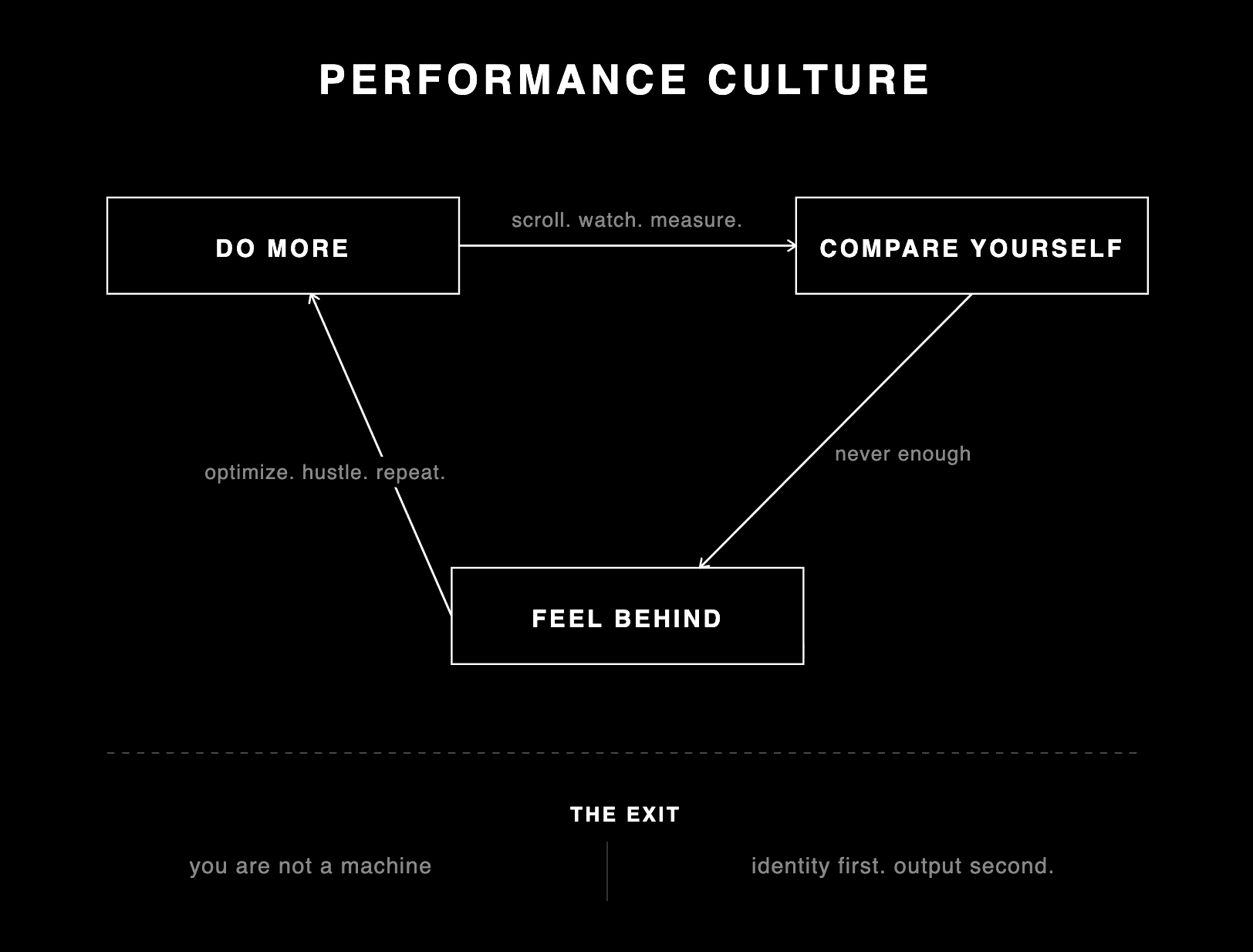
We live in a deeply performance-oriented culture. The message everywhere — social media, your environment, the self-improvement space itself — is that you need to be doing more. Always optimizing. Always improving. Always searching for the next hack, the next system, the next version of yourself.
And when you're on your phone all day watching other people post their results, you feel like everyone has success except you. You want quick money. Quick results. Quick everything.
But you're a human, not a machine. You can mess up. You can take more time. You're allowed to do the things that actually make you happy — not just the things that perform well on Instagram.
The problem isn't that you're lazy. The problem is that you've been measuring your worth by how many things you can execute simultaneously — and that's not a standard any human can sustain.
The "Must" Trap: Why Willpower Doesn't Work
About five years ago, I tried to start my own business. I had the strategy. I had the plan. I knew what I had to do.
And I did it — for two weeks.
Then I stopped. Not because I was lazy. But because I kept going from a place of "I must do this, I have to do that." That pressure built up, and the moment things got hard, my old self kicked in and said: this isn't you, slow down, stay comfortable.
That's what the "must" trap looks like. You set up a list of ten things you have to do, you white-knuckle it for a few days or weeks, and then you collapse back to zero.
Willpower runs out. Obligation feels like a threat. Your nervous system reads "I must do this" as pressure, and pressure — for guys who've spent years in survival mode — registers as danger.
That's why you stop. Not because you're weak. Because you're operating from the wrong place.
Identity-Based Action vs. Quick Fixes
Here's the shift that changed everything for me.
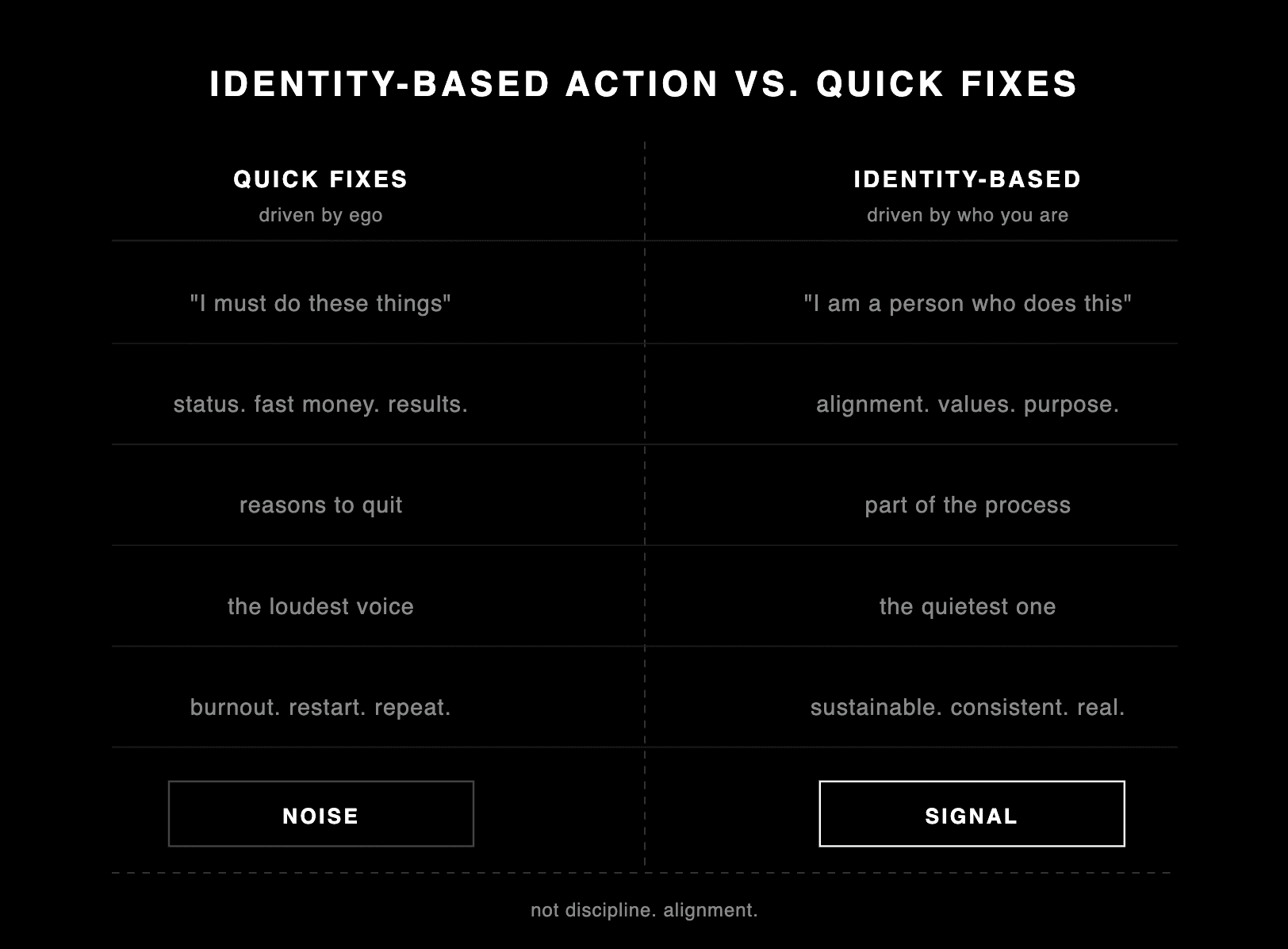
Going from "I must do these ten things" to "I am a person who does this" — that's where it actually changes.
When your actions are tied to your identity instead of your to-do list, hard days stop being reasons to quit. You don't skip the gym because you don't feel like it — because you're someone who shows up regardless of how you feel. That's just who you are.
This is what I mean by identity-based thinking. And it's the opposite of chasing quick fixes.
Quick fixes feed the ego. They promise status, fast money, visible results. And your ego wants all of that — right now, as loudly as possible. But the ego is not the real you. The ego is the loudest voice in the room, not the most honest one.
The real you already knows what you want. You just haven't listened yet — because that part of you is quieter than the noise.
When I started building my business and my life from identity — from who I am instead of what I have to do — everything became more sustainable. Because when hard things came, I kept going. Not out of discipline, but out of alignment.
How to Actually Find Direction
So practically speaking — what do you do?
Start with one question: what are one or two things you actually want to do long-term? Not the quickest path to money. Not what looks best to your friends. What actually matters to you — when the phone is off, when no one is watching.
Then ask: what kind of person do I want to be?
Write it down. Make it specific. Not "I want to be successful." That's hollow. Something like: I am someone who takes full responsibility for his life, shows up consistently, and gets better every day. Specific. Behavioral. Yours.
Once you have that, you stop making decisions based on pressure — and start making them based on identity. The question stops being "what do I have to do today" and becomes "what would the person I'm becoming do today."
That one shift cuts through almost all the confusion.
Then — start small. One thing. Not ten. Not a whole new routine overhauled overnight. One thing you commit to because it reflects who you're becoming. Build from there.
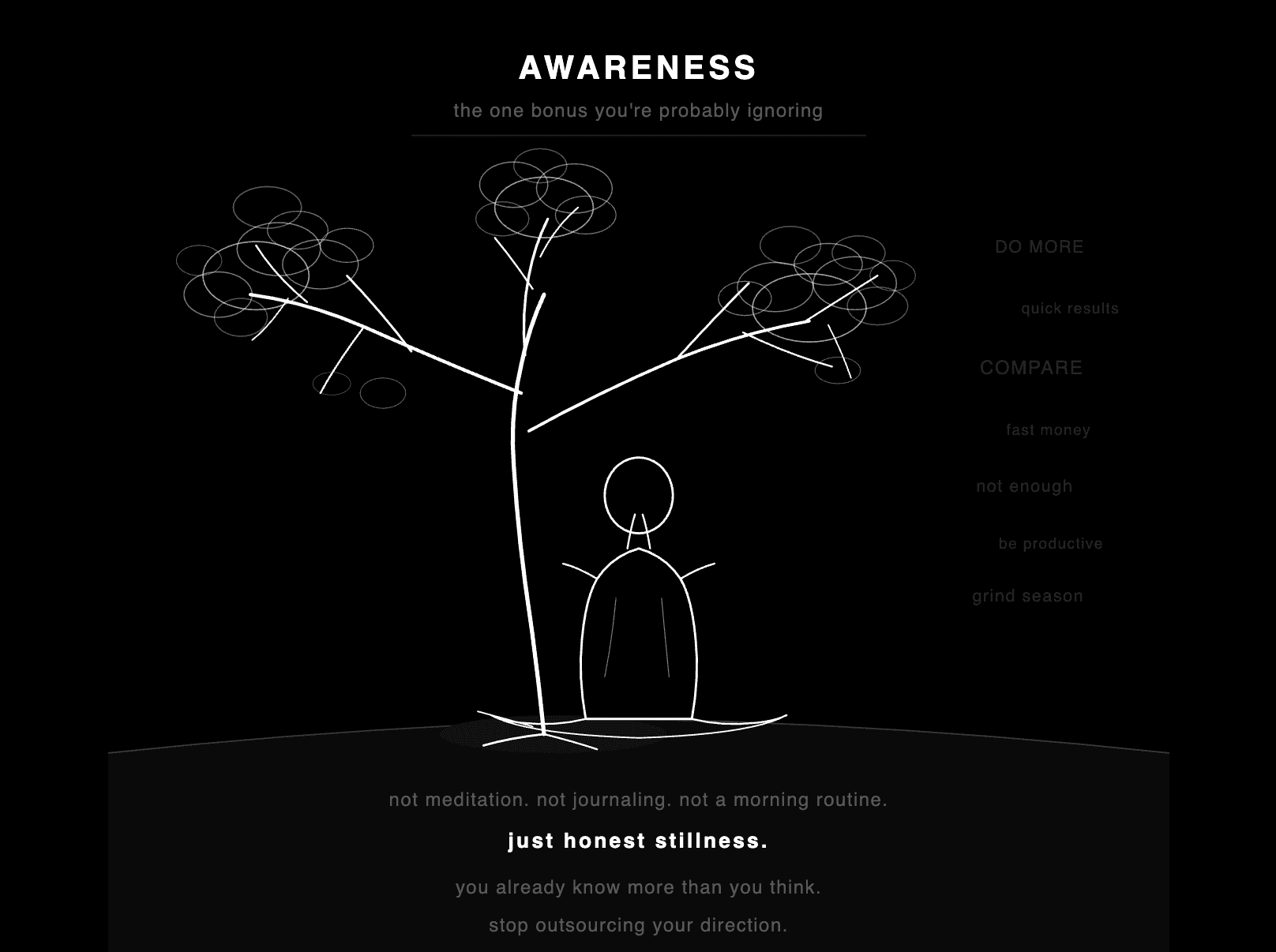
The One Bonus You're Probably Ignoring
Awareness.
Not meditation, not journaling, not a morning routine. Just honest awareness of why things aren't working.
Some things don't work because they're the wrong approach. Some things don't work because you haven't given them enough time. Some things don't work because you're chasing someone else's version of success.
You need to be able to tell the difference — and you can only do that if you slow down enough to look honestly at yourself.
Most guys who feel lost are moving too fast through the wrong things, trying to outrun the discomfort of not knowing. Awareness means stopping, looking at where the resistance actually is, and asking a better question than "why am I failing" — ask "what is this resistance telling me about what I actually want."
You already know more than you think. You just have to stop outsourcing your direction to everyone else long enough to hear it.
The Bottom Line
Feeling lost is not a character flaw. It's usually a signal that you've been operating from pressure instead of purpose.
Three things to take from this:
Stop trying to do everything at once. Pick one or two things that actually matter to you — not what social media tells you matters.
Move from "must" to "am." Stop building your routine around obligation. Start building it around identity. Who do you want to be — and what does that person do?
Stay aware. Don't just grind. Understand why certain things aren't working. That awareness is what separates guys who keep spinning from guys who actually move forward.
The way out isn't more hustle. It's more honesty — with yourself, about what you actually want, and who you actually are.
Start there.
FAQ
Why do I feel lost in life even when everything looks fine from the outside?
Because feeling lost is usually an internal problem, not an external one. When your actions and habits are driven by pressure, comparison, or what others expect of you — instead of by your own values — you feel empty regardless of what you've built on the surface. The gap between your identity and your daily life is where that emptiness lives.
Is it normal to feel like you have no direction in your 20s?
Very normal — and very common. Your 20s are when the gap between who you were told to be and who you actually are starts to become impossible to ignore. Most guys in their early-to-mid 20s are still running someone else's operating system. Recognizing that is the first real step forward.
What's the difference between feeling lazy and feeling lost?
Laziness is choosing comfort over effort when you know what to do. Feeling lost is not knowing what to do — or doing things that feel disconnected from who you actually are. Most guys who label themselves "lazy" are actually just doing the wrong things, for the wrong reasons, and burning out from the pressure of it.
How do I stop comparing myself to others and feeling behind?
The comparison doesn't go away by ignoring it. It goes away when you have something of your own to measure yourself against. Define your own values, your own version of growth, your own identity. When you have that, other people's success stops feeling like a threat and starts feeling irrelevant.
Can coaching help when you feel lost and have no direction?
Yes — especially when the lostness goes deeper than just "I don't know what to do." At BuildByIdentity, the work is about identity first: clarifying who you are, what you actually want, and what's been keeping you stuck. That foundation changes everything else. If this resonates, reach out here.
Ronald Foks is the founder of BuildByIdentity — a coaching practice for young men focused on identity, mental strength, and becoming the best version of yourself. He grew up in foster care, overcame trauma and insecurity, and turned those experiences into a real coaching methodology. He works 1:1 with clients who are done with surface-level self-help.
Watch the video version here
You wake up. You scroll. You see another guy your age launching a business, building his body, traveling the world — and you're still here, stuck in the same spot, wondering what the hell is wrong with you.
You have this feeling that you have no direction. That everyone around you has it figured out except you. That you should be further along by now.
I know that feeling. Most of my teenage years I felt exactly that way.
But here's what I also figured out: there's a way out. And it probably starts with something you're not expecting — you might just be doing too much, and for all the wrong reasons.
In this article, I'll break down why you feel lost, what's actually keeping you stuck, and the one shift that changed everything for me.
→ Scroll down to watch the YouTube video of this article.
Why You Feel Lost in Life
First, let's be honest about what's actually going on.
Feeling lost isn't just about not knowing what career to pick or what goal to chase. It's deeper than that. It's this low-grade weight of emptiness — the feeling that you don't belong anywhere, that you're falling behind, that something is fundamentally wrong with you.
Most guys who feel this way share the same pattern: they're overwhelmed by everything they think they should be doing, and underwhelmed by everything they're actually doing.
You tell yourself you need to hit the gym every day, read five pages every morning, build your business, improve your social skills, quit bad habits — all at the same time. And when you don't? You feel like a failure. Not just someone who missed a workout. A failure as a person.
That weight is exhausting. And it's not driving you forward — it's keeping you stuck.
The Problem With Performance Culture
Here's something nobody talks about enough, especially in Western Europe where I'm from.
We live in a deeply performance-oriented culture. The message everywhere — social media, your environment, the self-improvement space itself — is that you need to be doing more. Always optimizing. Always improving. Always searching for the next hack, the next system, the next version of yourself.
And when you're on your phone all day watching other people post their results, you feel like everyone has success except you. You want quick money. Quick results. Quick everything.
But you're a human, not a machine. You can mess up. You can take more time. You're allowed to do the things that actually make you happy — not just the things that perform well on Instagram.
The problem isn't that you're lazy. The problem is that you've been measuring your worth by how many things you can execute simultaneously — and that's not a standard any human can sustain.
The "Must" Trap: Why Willpower Doesn't Work
About five years ago, I tried to start my own business. I had the strategy. I had the plan. I knew what I had to do.
And I did it — for two weeks.
Then I stopped. Not because I was lazy. But because I kept going from a place of "I must do this, I have to do that." That pressure built up, and the moment things got hard, my old self kicked in and said: this isn't you, slow down, stay comfortable.
That's what the "must" trap looks like. You set up a list of ten things you have to do, you white-knuckle it for a few days or weeks, and then you collapse back to zero.
Willpower runs out. Obligation feels like a threat. Your nervous system reads "I must do this" as pressure, and pressure — for guys who've spent years in survival mode — registers as danger.
That's why you stop. Not because you're weak. Because you're operating from the wrong place.
Identity-Based Action vs. Quick Fixes
Here's the shift that changed everything for me.
Going from "I must do these ten things" to "I am a person who does this" — that's where it actually changes.
When your actions are tied to your identity instead of your to-do list, hard days stop being reasons to quit. You don't skip the gym because you don't feel like it — because you're someone who shows up regardless of how you feel. That's just who you are.
This is what I mean by identity-based thinking. And it's the opposite of chasing quick fixes.
Quick fixes feed the ego. They promise status, fast money, visible results. And your ego wants all of that — right now, as loudly as possible. But the ego is not the real you. The ego is the loudest voice in the room, not the most honest one.
The real you already knows what you want. You just haven't listened yet — because that part of you is quieter than the noise.
When I started building my business and my life from identity — from who I am instead of what I have to do — everything became more sustainable. Because when hard things came, I kept going. Not out of discipline, but out of alignment.
How to Actually Find Direction
So practically speaking — what do you do?
Start with one question: what are one or two things you actually want to do long-term? Not the quickest path to money. Not what looks best to your friends. What actually matters to you — when the phone is off, when no one is watching.
Then ask: what kind of person do I want to be?
Write it down. Make it specific. Not "I want to be successful." That's hollow. Something like: I am someone who takes full responsibility for his life, shows up consistently, and gets better every day. Specific. Behavioral. Yours.
Once you have that, you stop making decisions based on pressure — and start making them based on identity. The question stops being "what do I have to do today" and becomes "what would the person I'm becoming do today."
That one shift cuts through almost all the confusion.
Then — start small. One thing. Not ten. Not a whole new routine overhauled overnight. One thing you commit to because it reflects who you're becoming. Build from there.
The One Bonus You're Probably Ignoring
Awareness.
Not meditation, not journaling, not a morning routine. Just honest awareness of why things aren't working.
Some things don't work because they're the wrong approach. Some things don't work because you haven't given them enough time. Some things don't work because you're chasing someone else's version of success.
You need to be able to tell the difference — and you can only do that if you slow down enough to look honestly at yourself.
Most guys who feel lost are moving too fast through the wrong things, trying to outrun the discomfort of not knowing. Awareness means stopping, looking at where the resistance actually is, and asking a better question than "why am I failing" — ask "what is this resistance telling me about what I actually want."
You already know more than you think. You just have to stop outsourcing your direction to everyone else long enough to hear it.
The Bottom Line
Feeling lost is not a character flaw. It's usually a signal that you've been operating from pressure instead of purpose.
Three things to take from this:
Stop trying to do everything at once. Pick one or two things that actually matter to you — not what social media tells you matters.
Move from "must" to "am." Stop building your routine around obligation. Start building it around identity. Who do you want to be — and what does that person do?
Stay aware. Don't just grind. Understand why certain things aren't working. That awareness is what separates guys who keep spinning from guys who actually move forward.
The way out isn't more hustle. It's more honesty — with yourself, about what you actually want, and who you actually are.
Start there.
FAQ
Why do I feel lost in life even when everything looks fine from the outside?
Because feeling lost is usually an internal problem, not an external one. When your actions and habits are driven by pressure, comparison, or what others expect of you — instead of by your own values — you feel empty regardless of what you've built on the surface. The gap between your identity and your daily life is where that emptiness lives.
Is it normal to feel like you have no direction in your 20s?
Very normal — and very common. Your 20s are when the gap between who you were told to be and who you actually are starts to become impossible to ignore. Most guys in their early-to-mid 20s are still running someone else's operating system. Recognizing that is the first real step forward.
What's the difference between feeling lazy and feeling lost?
Laziness is choosing comfort over effort when you know what to do. Feeling lost is not knowing what to do — or doing things that feel disconnected from who you actually are. Most guys who label themselves "lazy" are actually just doing the wrong things, for the wrong reasons, and burning out from the pressure of it.
How do I stop comparing myself to others and feeling behind?
The comparison doesn't go away by ignoring it. It goes away when you have something of your own to measure yourself against. Define your own values, your own version of growth, your own identity. When you have that, other people's success stops feeling like a threat and starts feeling irrelevant.
Can coaching help when you feel lost and have no direction?
Yes — especially when the lostness goes deeper than just "I don't know what to do." At BuildByIdentity, the work is about identity first: clarifying who you are, what you actually want, and what's been keeping you stuck. That foundation changes everything else. If this resonates, reach out here.
Ronald Foks is the founder of BuildByIdentity — a coaching practice for young men focused on identity, mental strength, and becoming the best version of yourself. He grew up in foster care, overcame trauma and insecurity, and turned those experiences into a real coaching methodology. He works 1:1 with clients who are done with surface-level self-help.
Watch the video version here
Post Navigation
Back to Blog
About
Coaching
Social
Contact